
Call
+971 585 516 635
22nd October 2026
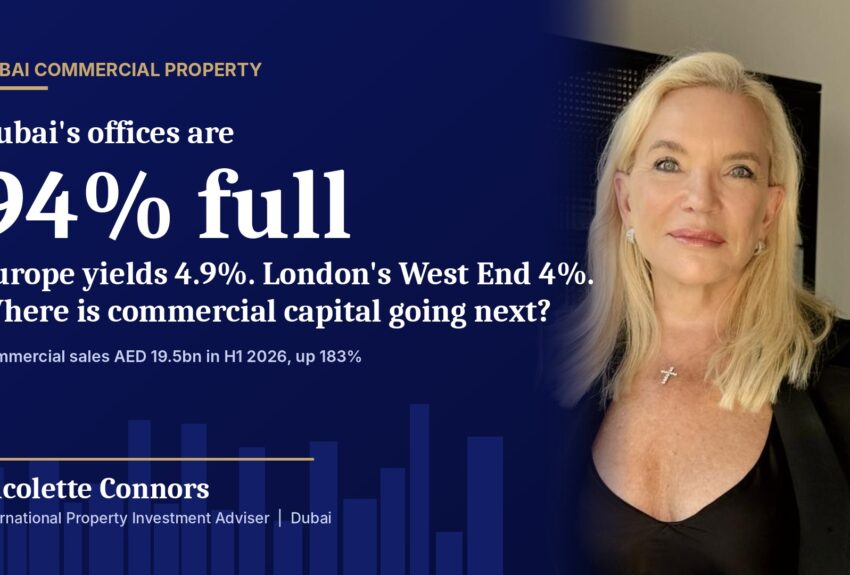
Dubai commercial property has just had its strongest half-year on record. While Europe and the UK work through a slow recovery, Dubai is running short of Grade A office space.
Dubai commercial sales (offices and retail) reached AED 19.5 billion in the first half of 2026. That is up 183% on a year earlier and already more than the whole of 2025. Offices made up more than 80% of that value.
So what is driving it, and how does it compare with the markets most of my clients already own?
Dubai: a supply story
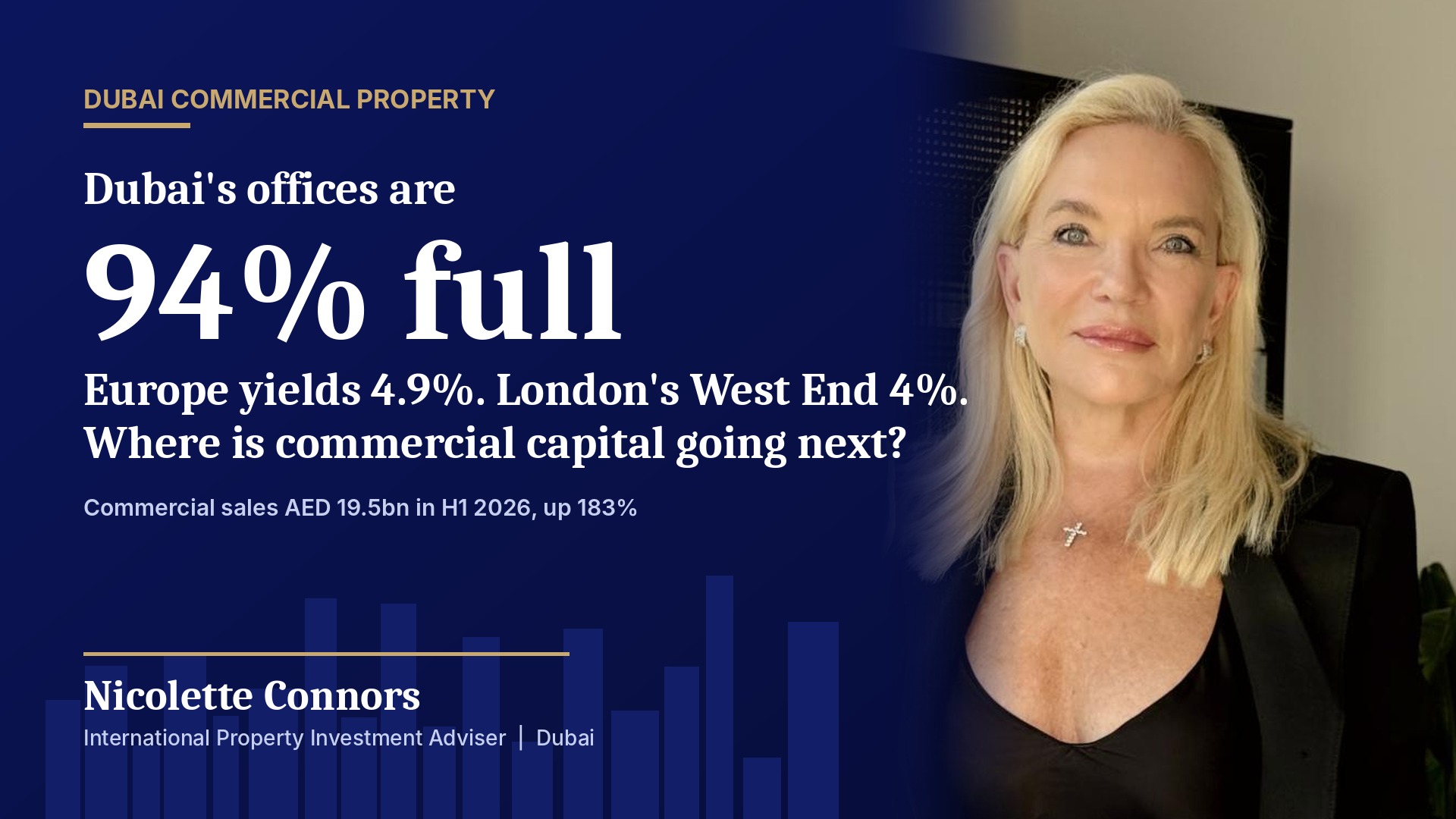
Dubai office occupancy is around 94%. Average office rents rose 13% in the year to Q2 and prime rents rose 16% (CBRE). Retail occupancy is around 98%.
The fundamentals are simple. Most UAE business licences still require a physical office, the population keeps growing, and very little new Grade A space is due before 2028. Companies keep relocating and expanding here, and they are competing for a small number of top-tier buildings.
You can see where the market is heading in the new towers rising along Sheikh Zayed Road and in Business Bay: Grade A+ floors, private members’ clubs, wellness facilities and direct metro access. Five years ago, buildings like this were rare in Dubai. Now occupiers expect them, and they are the hardest space to find.
Europe: slow recovery, wide gaps between cities
Europe’s average prime office yield is 4.9% (Savills, Q1 2026). Office vacancy across the continent reached 9.6% in June, up 40 basis points on a year earlier. Office take-up across 18 major European cities fell 9% in the first half of 2026.
There is real strength at the very top. Prime rents rose 6.2% year on year, led by Barcelona and Milan. But average net effective rents rose just 1.0%. The best buildings are pulling ahead and everything else is standing still. Investors in Europe are paying low yields for prime assets and taking real vacancy risk on the rest.
UK: good value, but patience required
UK commercial capital values fell 0.9% in Q3 2026 as yields moved outward (CBRE). Prime City of London offices yield around 5.25% and the West End around 4.00%.
To be fair to the UK, many sectors are priced above their long-run yield averages. Patient capital may well be rewarded there. But for investors who want income now, the numbers are modest.
How they compare
- Prime office yields: Europe averages 4.9% and London’s West End is around 4.0%. Prime Dubai office yields are commonly 6–8% gross.
- Occupancy: Dubai offices are about 94% occupied. Europe’s office vacancy is 9.6%.
- Currency: Dubai rents are paid in dirhams, which are pegged to the US dollar. For a sterling or euro portfolio, that is genuine diversification.
- Taxes: There is no local tax on rental income in Dubai. Investors still need advice on tax in their home country.
The honest caveats
Dubai is not a one-way bet, and nobody should present it as one.
Office rents have held flat for the past two quarters, at around AED 238–241 per sq ft. The market is moving from rapid growth to a more balanced phase. Hotel-dependent assets have had a difficult year. Dubai yields are usually quoted gross, so service charges, VAT and vacancy periods need to be underwritten before anyone compares them with European net yields. Selling a commercial property can also take longer than selling a home.
For me, this is where the opportunity sits. It’s not about chasing last year’s price growth. It’s about buying well-located, income-producing assets at sensible entry prices while new supply stays limited.
Where this fits in a portfolio
Most of the UK and European investors I speak with are heavily weighted to their home markets. Dubai commercial property gives them income from a different economic cycle, in a dollar-linked currency, in a market that is short of the space occupiers want.
If you advise clients, or invest yourself, and would like a confidential conversation about Dubai commercial opportunities, including off-market buildings and floors, message me “COMMERCIAL” on WhatsApp.
Nicolette Connors is an international property investment strategist based in Dubai, with more than 20 years’ experience and over USD 2 billion in property transactions across the UAE, UK, Europe, Australia and New Zealand.
WhatsApp +971 58 551 6635 | nicoletteinvestdubai@gmail.com | LinkedIn | Instagram: @Nicoletteinvestuae | RERA Broker Card No. 94957
Sources: CBRE Middle East, Savills, BNP Paribas Real Estate, CBRE UK, Dubai Land Department data. For information only; not financial advice.
This article was first published on LinkedIn.

Nicolette Connors
Author

Recent post


NICOLETTE CONNORS International Property Strategist & Investment Director. Helping high-net-worth investors build secure, tax-efficient portfolios in Dubai. Trusted advice grounded in integrity and 20+ years of experience.
Can we help you?
Open Chat