
Call
+971 585 516 635
22nd October 2026
Part of my remit for my investor clients is to research property markets around the world, test them against the facts, and decide where I’m comfortable putting their money. That’s why I’m building international property portfolios for my investors. Each market has to earn its place, judged on the strength of the opportunity, the risks, and how well I can protect my clients.
Dubai and Abu Dhabi remain core markets in those portfolios. Over the past year, though, I’ve watched investors from Australia, the UK, Europe and Asia turn to a market that offers something few others can at this price: Bali. Australians in particular have shown a huge appetite for it. So I did the research.
Why investors are looking offshore
Owning investment property at home has become harder and less rewarding. In Australia, the cash rate sits at 4.60%. Negative gearing on established homes bought after 12 May 2026 has been restricted, and the capital gains tax discount changes from July 2027. Gross rental yields average under 4%.
It’s not just Australia. In the UK, prices have been flat for a year, and landlords face a 5% stamp duty surcharge and tougher rental laws. New Zealand values are still falling. In the US, the median home price hit a record US$417,500, with mortgage rates around 7%.
Investors everywhere are asking the same question: where can I still buy at a sensible price and earn a real income?
Bali: the opportunity
Bali welcomed a record 6.95 million international visitors in 2025, almost 10% more than the year before. More than 1.6 million of them were Australian, nearly a quarter of all arrivals. Australians are also the largest group of foreign property buyers. They are followed by Europeans, Americans and Singaporeans, a fast-growing number of Indian investors, and Russian buyers active in the US$200,000–500,000 range.
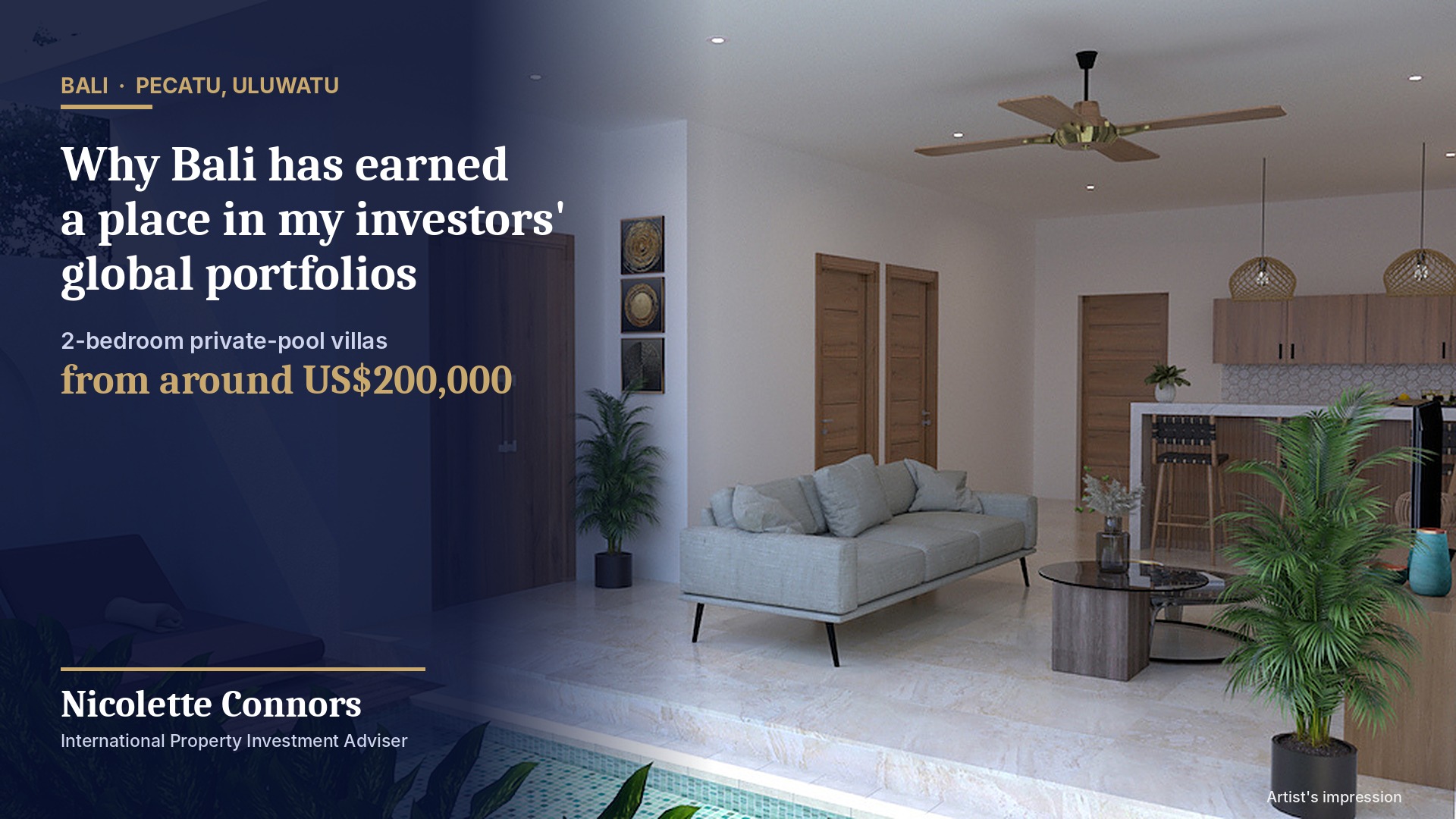
The entry price is what makes Bali stand out. For around US$200,000, a buyer can own a new, fully furnished, two-bedroom private-pool villa in Pecatu, near Uluwatu. It comes with a 7% net rental guarantee for the first 12 months, roughly US$14,000 in year one.
The same villa can be an investment, a holiday home and, eventually, a retirement home. Indonesia offers a dedicated retirement visa for over-55s, and many people are choosing to retire in Bali for a quality of life that would cost several times as much at home.
There is also a supply story. After deadly floods in September 2025, Bali’s Governor moved to stop farmland being converted into villas and hotels. A provincial law in force since February 2026 now limits building on productive land and bans nominee ownership. Legally developable land is becoming scarcer, and well-located, compliant villas should benefit.
The concerns, and there are plenty
I wouldn’t be doing my job if I only told you the good news. These are the risks I investigated before recommending anything:
- Scams and money sent offshore. Buyers have wired money to people they’d never met and lost it.
- Unfinished builds. Some developers have collected payments and failed to deliver.
- Building quality. Construction standards in Bali vary enormously, and enforcement can be inconsistent.
- Illegal land and permits. Some villas have been built on farmland or without the right permits. The 2025 floods hit hardest in areas built on converted rice fields.
- Nominee ownership. Foreigners once “owned” land through an Indonesian nominee. That is now explicitly banned.
- Short leases with uncertain renewals. Many Bali leases run for 25 or 30 years with only an “option to renew”. The landowner can name their price at the end, or refuse.
- Oversupply in some areas. Canggu and other popular areas have seen a wave of new villas, and rental income per listing has fallen in parts of the island. Location and management matter more than ever.
How I’ve protected my clients
These are the protections I insisted on before recommending these villas.
- Your money is released one stage at a time, and only with your approval. Client funds are held in escrow by an independent third party, and you only fund the next stage of the build. Before anything is released, the developer must prove the materials are on site, and you must sign off on the completed work. If something isn’t right, the funds stay in escrow until it is.
- An Australian developer, building to Australian standards. This was important to me. An Australian company is accountable under Australian law, and its reputation at home depends on delivering. Every build is supervised by certified Australian tradespeople and backed by a 5-year structural and wet-season warranty. For a buyer thousands of kilometres away, that accountability is worth a great deal.
- A 20 + 20 + 20 year lease, secured in writing. This is not usual in Bali. Most leases offer a single term with an “option to renew” that depends on negotiating with the landowner. What I sought for my clients is an initial 20-year lease with two further 20-year renewals, up to 60 years in total. It is secured by three notarised agreements with the landowner and a renewal clause. If you’re buying anywhere in Bali, this is the structure you should be negotiating for. The lease and its renewal rights can also be sold to another buyer at any time.
- Correctly zoned land with full permits and rental licensing. No farmland and no nominee structures.
- Carefully researched locations. The developer releases only a limited number of villas at a time, rather than building wherever land is cheapest.
- Professional management from day one, with a 7% net rental guarantee for the first 12 months.
I’ve reviewed each of these protections myself before putting these villas in front of my clients, and I can help coordinate funding and rental management for buyers wherever they live.
My view
For an investor who wants real income, a lifestyle asset and a possible retirement home for around US$200,000, Bali is one of the most compelling opportunities I’ve researched this year. That holds only if the right protections are in place. Without them, I wouldn’t touch it.
If you’d like to know more, or to register your interest in the next release, message me “BALI” on WhatsApp.
Nicolette Connors is an international property investment strategist based in Dubai, with more than 20 years’ experience and over US$2 billion in property transactions across the UAE, UK, Europe, Australia and New Zealand.
WhatsApp +971 58 551 6635 | nicoletteinvestdubai@gmail.com | LinkedIn | Instagram: @Nicoletteinvestuae | RERA Broker Card No. 94957
Sources: BPS-Statistics Indonesia (Bali Province); Bali Provincial Regulation 4/2026; Lloyds House Price Index; National Association of Realtors; Cotality NZ; developer information (October 2026). Rental guarantee applies to the first 12 months only. For information only; not financial, legal or tax advice.

Nicolette Connors
Author

Recent post

NICOLETTE CONNORS International Property Strategist & Investment Director. Helping high-net-worth investors build secure, tax-efficient portfolios in Dubai. Trusted advice grounded in integrity and 20+ years of experience.
Can we help you?
Open Chat